St Hilda's College
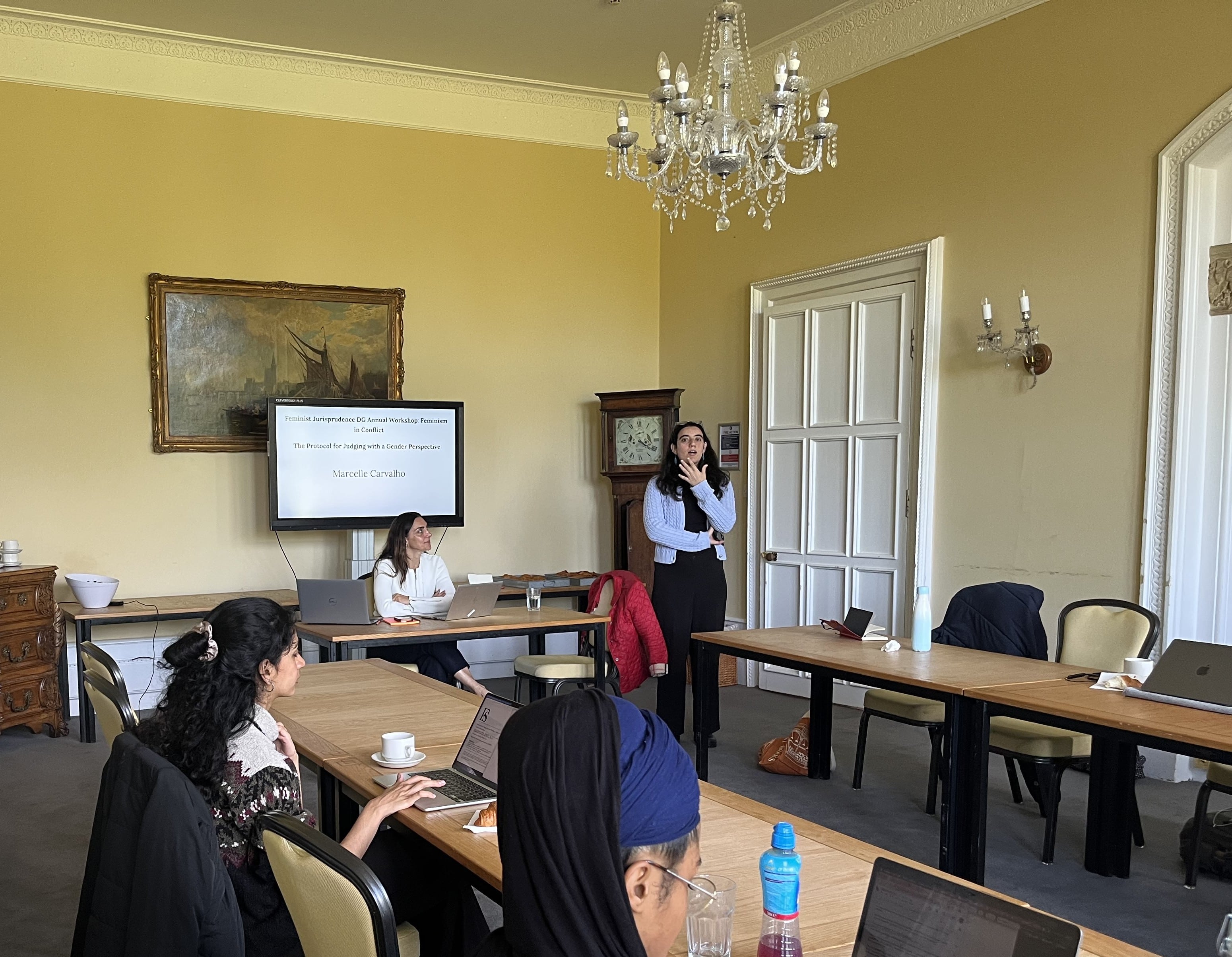
Feminist Jurisprudence Discussion Group held their sixth annual workshop titled ‘Feminism in Conflict’ at St. Hilda’s College on 9th June 2026. The FJDG Annual Workshop was an opportunity for the feminist researchers in Oxford, universities in the UK and abroad to engage with their peers in solidarity, discuss issues of common interest, and provide feedback on each other’s work. Judge Marcelle Ragazoni Carvalho Ferreira from the Federal Small Claims Appellate Court in Brazil delivered the keynote speech. In her keynote, Judge Ferreira discussed the ‘Protocol for Judging with a Gender Perspective’ followed by the Brazilian courts. She argued that diversity is not only a matter of ethical commitment and human rights, but also an institutional strategy to strengthen governance and public confidence in the judiciary. The keynote speech was followed by eight presentations that grappled with feminism in conflict in a variety of ways.
The first panel focused on feminist conflicts emanating from ruptures in family and intimacy. Elsa Horne (Oxford) analysed the role of the ‘Private Law Pathfinder,’ a pilot program by the UK government to improve the family court experiences and outcomes for children and parents, in appreciating the nuances of multiple roles of women in a familial context. Amala Dasarathi (SOAS) introduced the novel use of the writ of habeus corpus in India - to produce the body before the court - by lovers whose partners are held in the custody of the parents and parents in attempts to recover their children who have eloped. Vasudha Chandwani (SOAS) spoke about the lack of recognition for the contributions of women’s labour within India’s marital property regimes. Her presentation captured the conflicts of feminist vs legal marital property and conflicts arising from the plural legal system of India. The second panel dealt with conflicts surrounding the concept of agency. Co-presenters Vibha Swaminathan (Oxford) and Riya Sharma (Advocate & Researcher) discussed agency in the context of marriage, and Garima Choudry (SOAS) discussed agency in relation to surrogacy in India. The third panel brought to the spotlight repression and recognition for women’s rights in international law. Larissa Tavares de Freitas (Campania Vanvitelli, Italy) conceptualised failures of international law in relation to gender apartheid. Thanika Kaur-Scille (LSE) exposed the structural erasure of minority women in global health governance. Karla Bayas (Oxford) closed the workshop with a discussion of the women’s rights implicated in the human rights violations arising from Ecuador’s 2026 Mining Reform.